So we have seen An Inconvenient Truth now. Maybe some of you have already watched or read Gore's recent "challenge" speech (assigned for next week). This post will give you a place to continue the conversation about them.
Both of the two Gore examples (the movie and the new speech) make nice case studies that we can use in order to reflect a little about public policy processes. [Maybe you learnt something about the climate change issue too.]
We had some discussion in class which encouraged you to think of Gore's slideshow as part of one or more of the stages in the policy process. We'll be learning more about that over the next few weeks.
Other angles?
Your discussions in class on Thursday may also have started to touch on some other angles that are relevant to our course, including:
- an 'Actors and Institutions' angle (relevant to next week's classes): Who is Gore? What role is he playing? Is he a one-man show, or are there organisations in the background? Who (or what) is he seeking to influence? Would it matter if he were mainly speaking to people who already agree with him? What institutions does he mention as relevant?
- Is there 'rational policy analysis' here or are these primarily political communications? Is he being too emotive? Would he be more or less effective if he presented the data more carefully and scientifically and refrained from implying that correlation equals causality? Is he talking to our heads or our hearts mainly? And is there anything wrong with that? Notice that he accuses his opponents of being misleading in the ways that they seek to 'reframe' the issue. How does he 'reframe it'? Deborah Stone's book is helpful for thinking about these angles.
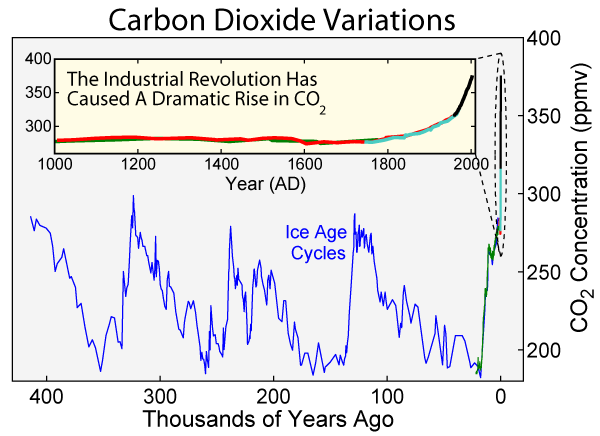 Image by Robert A. Rohde for Global Warming Art (via Wikimedia Commons)
29 comments:
Hi, a few quick thoughts regarding this class to get the ball rolling.
1) The (unnecessary) footage of Gore's defeat to Bush as well as other parts of his life unrelated to the climate change issue in the movie, to me, is indicative that a part of his agenda for pursuing change is to pander to his own ego. I can't help shrugging off the feeling that unable to be President, Gore has chosen instead to be the new messiah of human salvation through "saving" them from global warming.
2) This leads on to the fact that the movie/presentation stems from his activism and thus is one-sided to his own goals. Without a contextual background, any normative analysis is moot since there is nothing to act as counterweight to what he says. The equivalent would be going to a debate where only the proposition presents and then deciding if they were right.
3) An aspect of his presentation, his 'evidence', is the use of stories. While it is a powerful emotive tool that can be used to affect the masses (especially the average American), the academic or policy analyst must realise that anecdotal evidence is inherently weak without statistical validation, and even statistics can be played with to different effect. Note the scales he uses for the different graphs to make his points. While his method of storytelling might appeal to a less discerning audience, a closer examination would reveal it smacks of charlatanry.
4) Thus, my personal feeling is that given the present materials, we are unable to judge Gore's policy in terms of its rationality. Instead, we are to observe the individual gears of the behemoth that is bringing about policy changes to stop global warming. Personally I haven't read up enough to discuss this, maybe those of you who are more well-read can enlighten us. =)
This comment is in relation to the movie "An Inconvenient Truth", and our Week 2 prescribed reading on Al Gore’s speech, A Generational Challenge to Repower America
Al Gore has a bold dream, one that challenges the United States to be running on zero-carbon electricity within 10 years. The technology may be present today for such a feat to be achieved, however many different forces will resist such change. The ability and determination of the American people and their political leaders to push through such changes remain highly uncertain.
Government political will and leadership to initiate such sweeping nation-wide changes are key. However, many of the American politicians today enjoy substantial support from major conglomerates such as the oil and gas companies. As a simple example, much speculation has been made about how President George W. Bush has had the support of major oil companies throughout his term of office. These oil companies have also supported Republican Presidential Candidate John McCain in his bid to continue the Republican hold on the American Presidency. Democrat Obama also receives his share of contributions from the gas industry.
Even if one were to take such information at a superficial level, it is clear that it would be unlikely for these US leaders to turn against some of their largest contributing supporters. No one can reasonably fault these energy companies from utilizing such strategies to ensure their survival; it is the smart thing to do (most of us in the leadership positions of these companies would do the same), although one must acknowledge that some of these companies also have other motivations for pursuing such actions.
Apart from the lack of will from the leadership of the Americans to effect such climate-friendly change, it is also questionable whether the massive infrastructural reconditioning and expansion of the nation’s present electrical grid can be achieved within Gore’s target of 10 years. It would be unrealistic to assume total support from all levels of the American society for such action despite its seemingly utilitarian appeal. As such, one would expect differing levels of resistance permeating from various stakeholders within the American society which would effectively retard potential plans to realize the necessary electrical infrastructure in support of a zero-carbon electricity consuming America.
The people of America will not make a dramatic switch to electrical cars unless such infrastructure is firmly in place, lest they fall victim to problem that Singaporeans drivers who have “upgraded” their engines to support CNG usage have been complaining about recently – the lack of CNG stations around the island.
The cost for the upgrading and installation of the infrastructure that is necessary to make Gore’s dream a reality is yet another stumbling block. America is in debt, borrowing heavily from the global community to fund their expenditure and to support the world’s largest economy. No doubt such capital investment would reap great rewards in the future, however one would question whether the spending habits of Americans, and more importantly that of their political leaders, would change sufficiently to support such long-term plans as opposed to the present short-term luxuries many Americans seem to prefer. One must often bear in mind that as the track record shows, there always seems to be higher priorities in the government agenda for investment or expenditure in other areas such as military defence rather than in alternative energy infrastructure.
One of the key arguments that can be gathered from Gore’s speech is that of the rising cost of oil. Oil had peaked above $147 in mid-July and has now been cooling off around the $114 region. There has been much speculation about the future direction of oil, but one thing that should be rather certain is that it will not fall far below the $90 to $110 region in the near future. Although some analysts have argued on the slowing boom in China after the Olympics and thus consequentially a slowing global demand (which may slow down global economic expansion), in pursuing a very superficial argument - unless there is significant disinterest from people in owning cars or they all turn towards owning electric or alternative energy powered cars, or unless the Organization of the Petroleum Exporting Countries acts to its own detriment and pursues strategies that allows weakening in oil prices such as to increase production output, there will still be strong fundamentals to support oil prices and thus rising cost of living and inflation.
On such a note, it does seem that unless a long-term solution (such as reliance on solar and wind energy as Gore has proposed) is acted upon, people in the world will all suffer from rising energy and commodities prices. Perhaps instead of expecting leadership from the West to initiate climate-friendly policies, maybe Asia could lead in this initiative. This rides on the argument about the shift in power and leadership back to the East, and could very well be the catalyst towards recognition about the rising influence of the East, especially among the staunchest rejecters of such a belief.
Zhong Yi
Hi, I also have few comments about the Al Gore's movie and speech. Though they are very similar to that of Wilson and Zhong Yi.
Firstly, it seems more like a political thing to me as several parts of his movie showed his defeat to Bush. Whereas, these clips had nothing to do with his prsesentation and his goals.
Secondly, I dont think that his target is right. He is targetting a very specific group of people who may or may not be interested in the climate change. I do agree that his agenda is right but all this information should not be concentrated to a specific group of people. He is not even addressing the people who can really do something about it.
Al Gore's one of the dream is 100 percent renewable and truly clean electricity within 10 years of time. I dont think that its very easy to shift to alternative energy sources in a span of 10 years as it is very cost effective too. The common people cannot afford to buy a hundered million solar system car for their common use.
He used many graphs and pictures in his presentation which may not be enough to address the issue of golbal warming. This is a worldwide issue and cannot be addressed without reliable statistics and research.
Irrespective of other drawbacks, I would say that it was also very informative in the sense that it takes our attention towards the serious issue of climate change and gives us some basic knowledge about golabal warming and its expected results.
My initial thoughts on the movie and the new speech as far as the study of the policy process is concerned: Al Gore is acting as an advocate to 'solve' the climate crisis and is clearly trying to set the agenda in the US on how the American nation should address climate change. He is 'reframing' the issue of climate change by leading his audience to think about it in relation to national security concerns (particularly US dependence on oil from foreign countries) and domestic economic problems such as unemployment. This I think is what Deborah Stone calls "political reasoning" or "strategic portrayal for persuasion's sake."
As far as his case is concerned (points raised, arguments put forward, and the evidence to support these), there are things that can be said to balance these or at least raise questions before accepting these as valid or even strong. One needs to know which "studies" by "experts" he was referring to at the beginning of his speech, for example, to verify the credibility and validity of their assertions. Or one also has to know the countries from which the US imports oil, in trying to evaluate Gore's linking of climate change with US national security concerns.
Having said these, politically speaking it is a challenge (to say the least) to criticize or question in the public arena the recipient (together with the UN Intergovernmental Panel on Climate Change) of the 2007 Nobel Peace Prize. Nonetheless, while Gore has a significant amount of political capital at his disposal, it is difficult to say how effective he can be in setting the policy agenda; other actors/institutions/stakeholders need to be considered as well in the context of the dynamics of American public policymaking.
The weakest link in Al Gore's speech was the lack of realistic solutions to the problems that he had raised.
As of 2006, electricity generation from "renewable sources" accounts for only 7% of USA's total electricity generation. (Source: http://www.eia.doe.gov/fuelrenewable.html). With power supply from renewable sources (such as solar and wind power) remaining intermittent, Al Gore's challenge to the Americans to run "on 100% zero-carbon electricity in 10 years" is almost farcical.
Anyway, to throw into greater relief the irony of this entire fiasco, Lorne Gunter noted that
1) Al Gore lives in a Tennessee mansion that produces a carbon footprint 20 times that of the average American home.
2) A sizable chunk of his personal fortune comes from royalties on a zinc mine which had to be temporarily closed five years ago in part because the Environmental Protection Agency ruled it one of the worst-polluting mine sites in the U.S.
3) Gore's Live Earth benefit concert last summer flew scores of rock bands to stages around the world in carbon-spewing private jets.
4) To cover the emissions from his own frequent use of private jets, Gore set up a company that buys carbon offsets, so that in effect he is paying himself for his carbon indulgences, writing off the expense on one hand, while pocketing the proceeds on the other.
Apparently if the world is ever to reach the carbon-free future Gore dreams of, it will have to get there without Al's help.
(See Lorne Gunter, “Inconvenient Indulgences: Do as Al says, not as Al does” The Vancouver Sun (23 July 2008)A.7.)
Rationale under “Inconvenient truth”
I found rational policy angle useful to identify advantages and drawbacks of Al Gore campaigning.
First, I think most will agree, that Al Gore:
- primary attacks hearts, not the minds;
- keeps emotive perspective;
- puts it as moral, not political issue.
It is worth using those instruments having an objective of raising awareness (political communications techniques). However, if Al Gore, as a policymaker is eager to make a change, he must strengthen rationale under the issue. He should shift from presenting “sad data” of climate change, to “cause-effect-solution” rational.
Assuming, that Al Gore is aimed to make a major change in climate change (not to pick political credits), he should move from “political campaigning” to “policy analysis and advocating”. In order to become known as a policy adviser, he should:
- use reliable data sources, known scientific reports;
- present data based and realistic policy papers;
- link energy with climate crisis.
In my opinion, the last point is crucially important, as climate change is problem caused by present energy production cluster. Solving the problem must be clearly based on tackling the root causes – the point sometimes forgotten by Al Gore. Actually, energy encompasses few more issues and emphasis on it would help gaining more public support -> take a look at US oil addiction issues
Evaluating the Effectiveness of Al Gore’s Campaign
On first look, Nobel Laureate Al Gore’s “An Inconvenient Truth” appeared to be both informative and persuasive, tugging at the heartstrings of his audience, who would have felt an instant connection to the message he was advocating – that we have to stop global warming before its too late.
I applaud his use of charts, diagrams, pictures, among other forms of statistics, to bolster and to legitimize his case. However, recent information has revealed that some of the information used in the film was false. In particular, it was revealed by ABC News that one of the famous shots of supposed Antarctic ice shelves in the film was actually a computer-generated image from the 2004 science fiction blockbuster "The Day After Tomorrow."
More importantly, a recent Gallup poll has also revealed that "a little more than a third [Americans] say they worry about [global warming] a great deal, a percentage that is roughly the same as the one Gallup measured 19 years ago." As such, it appears that despite Al Gore’s massive campaign to convince the world that global warming poses a real and imminent danger, Americans don’t seem to be buying into what he is saying.
One key correction that AL Gore should make is to ensure that his use of statistical data is correct, and this mandates that he chooses his statistical sources carefully. The use of reliable data sources is one important aspect to be fulfilled before one can be known as a policy adviser. Al Gore is certainly lacking in this aspect at the moment. Improvements are necessary if he wants to succeed in his campaign.
What I found lacking in the movie and what was pointed out by Justinas and Kuek Foo, was that he (conveniently) failed to talk about what can actually be done to reduce the effects of global warming. While he tried to make the movie feel personal with his stories he did not talk about how he had changed his lifestyle in order to leave a smaller carbon footprint. If he was counting on convincing the masses to change their ways of life or have an effect on policymakers, I feel he should have focused on this aspect a little bit more.
It also seemed like he was using the movie to make digs at the current administration.
Disclaimer: I present my views purely as a prima facie reaction to the documentary and believing that the motive of filming and popularizing the documentary was altruistic. In doing so, I might be digressing from the line that Paul fixes in the beginning but just like others, I just wanted to share what I feel. The policy approach here can be the role of media in shaping public policy.
Before commencing commenting, I would like the class and the faculty to go through the links below. The first one is about an anti-speeding campaign launched by Roads and Traffic Authority, NSW, Australia last year. The second link is about the impact of that campaign on the target audience.(Do not skip the links. The ad is brilliant and amongst my favorites in non profit category)
http://www.duncans.tv/2007/speeding-no-one-thinks-big-of-you
http://www.rta.nsw.gov.au/roadsafety/speedandspeedcameras/campaigns/index.html
Having mentioned the above ad, I would like to say
-that the issues presented in the movie are real. So even if there were personal and political angles involved, they don’t dilute the cause of the movie
-He is giving a global face to the problem and generating public opinion which then can lead to the generation of the much needed political will
-The layman might not understand much of statistics and technical information presented to him. The choice and revelation of the sources wouldnt have mattered in the documentary at all. Perhaps it was easier for him to mislead people with complex data and terms. And had he done so, the cynics would have hounded him saying 'How do you expect masses to understand it". But the curve measuring CO2 from Mauna Loa observatory, temperature records since 1880, data from Antarctic ice cores and others were enough to impress me
-he might have vested interests, but one should credit his efforts that he is already putting in. For one person, his efforts might be much more than those of one entire nation combined
-Bringing in his past family events was an integral part of making it a personal appeal. And I believe that they added to the efficacy of the message
-He does put the issue as a moral one and attracts (rather than attacks) more hearts than brain. I think that’s a good enough way to achieve what he wishes to achieve (public eye)
-More than anyone, he is appealing to youth of the world who really can bring about a sea change
The point I wanted to bring forth through the ad in the beginning is, the impact of visual media. The role of media in creating and shaping public opinion and public policy is extremely important.(Hence the elective too) as is evident by the ad and there are plenty of other examples. The documentary is a similar step.
The targeted audience included all the stakeholders. It questioned all the actors and institutions involved. The documentary did well on its part to create awareness and opinion about the issue. The policy solutions are needed beyond question. And he does mention few of them in the documentary. Its for the policymakers to execute them. He does his part by appealing for the same. If someone other than Gore might have made the same documentary, no one would have expected him to provide a policy panacea for this problem. Also, he only wrote the book and the screenplay. Suggestion of concrete solutions by him may also be limited by his own knowledge as an environment activist and not a scientist.
Most of all that is needed is a wish to see the change. And the movie if not anything else, says one thing point blank. “You must be the change you wish to see.”
Plus we can not comment on the potency of his drug until we had concrete information on the impact it had. Look at this. http://www.wecansolveit.org/content/success/
PS: Paul, I did not understand what this means 'Would it matter if he were mainly speaking to people who already agree with him?'
First, thank Paul for your updated guidance. I myself also think that the comments are going a little bit away from the original post's questions.
And here's my thoughts on the two case studies:
"An Inconvinient Truth" aims at raising public awareness about a problem that should be addressed by public policies. The movie's target audience is the general public (not only Americans) with some educational background whose opinion impacts indirectly but pervasively the policy process. By relating sometimes to his defeat in the presidential run, Gore might also aim at reminding the public about their voters' policy capacity. With regard to its main purpose, the movie did well.
Gore's speech may serve in the next stage of his policy-making process, to present a solution for a problem. Here Gore's role is the talk person for a think-tank behind him, trying to influence politicians who may have direct roles in policy-making.Yet, even if he were mainly speaking to people who already agree with him (and I think he was), the speech would still be important as a) it is a way of publicizing his think-tank's findings to further attract puplic attention on the issue; and b) it's needed to put pressure on political parties (and thus executives and ligislatives) to act on the problem.
The speech is mainly political communications despite Gore's effort to make it sound like there was objective, rational policy analysis. With regards to his target audience (who already agree with him at a certain level), and from his view of the matter as a "moral issue", I think his being very emotive and talking mainly to the "hearts" are strategically reasonable. Nevertheless, I agree that it could have been more effective and reached larger audience had Gore refrained from his implications.
Hope I will have more thoughts after Tuesday class:D!
My classmates had posted many sapiential remarks which enlightened me a lot.
In my opinion, Gore's strategy is through such public speech to expand social awareness about climate change, enlarge his social influence upon the mass who are also potential voters,i.e. the force who can influence the authority and the direction of policy, and seek more support to push the authorities in policy adjustment. From the audience's welcome and applause, we can see that undoubtly his efforts have gained some success and realized his goal of impacting on more people.
To some extent, it is just a general introduction with the outline of Climate change,the cause and effect.In such a time-limited speech,he cannot move so far to cover more specific methods to solve that problem, which are also not the focus and aim of him, but maybe will be elaborated in his later speech and report. We can look foward to that :)
In my eyes, after quitting from the position of vice-president, Gore now is not a professional scholar or politician,but acts more like a social activist.
I think most of the comments left by my other classmates are brilliant and in fact have pretty much covered most of the facts.
However, here's my two cents worth of opinion. In my view, i do think that Al Gore is doing a good job here painting the picture for us on how global warming actually does affect the world. But as mentioned and noticed, there were not much solutions introduced in this film and instead we are left with all this underlying problems.
i do not think the movie is for his own personal gain but more towards a global message wanting to be sent and put across to many people and thus the production of the movie...Also, the small segments of the movie on Al Gore himself and the lost in presidency is perhaps a simple biography of himself and it perhaps serves as an essential platform to allow us to know him better.
And as for the recent speech, i do think 10 years is a little ambitious and far fetched. Like Zhong Yi mentioned, the technology is out there..but would the energy companies comply to such solutions and measures? Would they change their primary focus to renewable resources? There would be resistance faced if such change were to be implemented.
And one other thing Al Gore mentioned was, "Electric Cars". I was just wondering if anyone has caught this documentary produced in 2006 called, "Who Killed the Electric Car?" Basically, it talks about the history of Electric Cars in specific, General Motors EV1, its developments, commercialisation and how almost all of the EV1's were called back and thus crushed. This film shows how the auto and oil industry may have worked to kill off the electric car era with Wally Rippel (long-time developer and advocate of battery electric vehicles) explaining how the oil companies fear of loosing out trillions in potential profit from their transportation fuel monopoly.
It is quite an interesting film if some of you have not seen it. The conspiracy in the film gives you a feel that there could be a hidden agenda somewhere, thus leading to the end of EV1s'.
CNG is however the new alternative in Singapore but like Zhong Yi mentioned as well, there are a lack of infrastructures to faciliate or encourage most of us, drivers, to optimise such utlisation.
Today's discussion, to some extent, can help us understand whether the Gore's actions are rational or not:
1. since the climate is a good that is non excludable but rival, policy needs to be made at the macro rather than the micro level regarding this.
2. left to the people, climate will go through the 'tragedy of the commons' where it will be exploited by all individual actors (refer to the overgrazing of fields example discussed in class today)
3. this happens because for people, there is an incentive mismatch since (looking at shorter time horizons) it pays if they exploit rather than conserve the environment.
4. therefore, it is necessary to control how much people pollute through one of the three ways: coercion, incentives and co option.
5. the government often fails because the party has to often look at the problem of reelections in the next elections. In order to secure a position for themselves, they need to pursue policies that appease the public NOW. Hence, they often avoid what Gore calls "hard" policies (with longer time horizons) because these wouldnt necessarily get them back into office
6. so what gore is trying to do is change the demands of the people. If people demand nature conserving policies, it will be in the interest of the political parties to pursue them. This way the policy of conserving the nature will be a rationally sound one.
Al Gore's speech and documentary were made to leave lasting images on the causes, impacts and possible solutions to climate change.
I think that Al Gore intended to touch both the hearts and minds of his audience. His speech was mainly political but it also contained scientific findings and statistics -- to his credit. Whether the data he presented are true or not is another issue.
I agree with Deborah Stone's view that it's the ideas that matter. I can say that from my experience in the process of treaty ratification, where it is necessary for the executive branch to get support from various actors (legislature and civil society).
A good policy proposal for me would have to carefully balance out the facts with feelings.
Policy making begins with a "good idea" but it does not end there. In order for a "good idea" to be implemented, one must be able to influence and convince the right people.
[As to Al Gore's target audience, I think in most part, he was talking to Americans and citizens of developed countries. That's logical since developed countries have the greater share of global emissions per capita. The UNFCCC states this as a fact.]
Thank you all for your useful contributions.
Well, when we consider the video "An Inconvenient Truth" and Al Gore's speech on July 17th, i feel that he is clearly trying to set the agenda on climate change at a personal (individual) level as well at the political level primarily in the US and at the same to a large extant at the global level since after all global warming is a global issue.
In the documentary he is trying to reach the hearts and minds of the American public. He is trying to empower the individual Americans by referring to their achievements, the abolishment of slavery, women's right to vote and so forth. He is trying to convince Americans that they need to rise and be leaders in addressing the very real issue of climate change.
In the speech of July 17, Al Gore acknowledges the attendance of political figures and calls for the presidential candidates to add the issue of climate changes to their agendas.
Additionally, I also feel that he frequently attacks the inability of the current Administration's inability to deal with many other issues let alone climate change. This perhaps to an extent is personal as he was rightly or wrongly beaten in the election against George W. Bush. Perhaps his speech of July 17 is a bit of a campaign for the Democratic party as he expresses that change is needed and that American Public including soldiers themselves are contributing to the Obama campaign and the US lead wars in the world for Oil is not serving them well.
In a way I am glad that he did not became the president of the US. Who knows, how much he received from the big oil companies during his campaign. Surely this would have influenced his actions in the White House. Now that he has more time to solely focus on this very real issue of global warming and climate change.
As many on our classmate have expressed, I also have questions on the achievability of the 10 year target to reach 100% renewable energy. To begin with the lack of political willingness and than the influences of big oil companies cannot be undermined.
I strongly believe that when J. F. Kennedy challenged he must have had evidence from NASA or who ever is responsible that his challenge can be met.
I also think that Asia has the capacity to lead this transformation as countries like Japan are so much more advanced on these fronts.
Sahudha
believe it or not, this is the first blog ever that i'm commenting on. so, thanks for the opportunity to break my 'hardware' conventions and make a move towards more 'software', which i'm finding really hard to soften.
and it's the first time i'm expressing an opinion re climate change/global warming in writing.
so, greetings to you all, and bear with me plz.
a) living in a small town in the heart of Pamir mountains, i've had little, if no concern for climate change. it just never bothered me; in fact, on the contrary, i sort of liked it because for the past three or so years we haven't had much snow fall and winters were pretty warm; so we didn't much suffer from the shortage of electricity because the water in the canal never froze and moreover, it maintained at a relatively high level throughout the winter. yet, i was sorry for people living in Dushanbe - the capital city of Tajikistan - who had the coldest winter ever which was exacerbated with shortage of electricity, water and gas (btw, there's no central heating system).
And when i was watching Al Gore i couldn't help reflecting on these changes and i began to suspect that it must've been the climate change effect.
And you know, to my very surprise again, i get a local paper headline saying: Glaciers are shrinking in Pamirs. yes, the article was talking about the rising of levels of water in the rivers due to extensive melting of ice in glaciers - which is related to global warming. bingo!
And yesterday, another surprise struck me: a listserv to which i'm subscribed announced the show of the 'Inconvinient Truth' in my little hometown. wow! hardly ever anyone speaks English; almost half of the houses don't have running water (and yes, toilets are outside); people struggle to bring food to the table ..... and yet, here goes Al Gore with his message!
I think it's a powerful one, and I don't think i can emphasize enough who he addresses, how he addresses, where he addresses, and so on, because if he's already up there (2110 meters above the sea) addressing mountain peoples, there's some legitimacy in his message.
ps: i hope it was not a bad start, huh? :-)
Hi everyone, it's been great reading your views! Here are my reactions:
In both the film and his speech, Gore challenges his audience (primarily the American public) to agree with his view that the survival of the nation is linked to the fate of humankind. It is interesting that he attempts to resolve the ideological stalemate by repositioning the issue of climate change as a ‘moral’ issue that is intertwined with the USA’s security interests and ultimately economic survival.
However, his main argument that it is imperative for the US to commit to producing “100percent of [their] electricity from renewable energy and truly carbon-free sources within 10 years” as the panacea for the country’s present woes is oversimplifying the issues at hand. The cause and effect link is just too direct and fails to consider the impact for instance, of the numerous actors (both domestic and international) who exert pressure on US policy makers and the decision-making process.
His argument fails to convince me because firstly, his ‘target’ audience is too broad and not segmented enough. If he intends to win the key stakeholders like the big businesses or decision-makers, his speech and film do not contain enough data, support from important experts on climate change whose appearance in the film could have strengthened his case or any strong measures on the way forward.
His methods of persuasion are at best only able to convince the less informed audience given its extensive use of American style political rhetoric (e.g. references like the moon-landing that are symbolically significant in the American public’s psyche) and more current experiences of climate-linked disasters. The use of personal images and examples from his family serve to heighten the emotional ‘core’ of the film and perhaps, attempt to enlist his political standing in order to lend credibility to the issue of climate change and more importantly, make it less abstract conceptually.
Secondly, by positioning his view as the only viable option, Gore may ironically strengthen the resolve of those in power to stick to the status quo since he sidesteps the issue of how his new movement could benefit them. Indeed, Gore fails to mention how the US government would fund the present inefficient grid system that cost US businesses more than $120billion annually nor does he address how fair compensation would be determined for “those Americans who would unfairly face hardship” in the interim period if the country decides to actively move towards using renewable energy sources. Hence, we see consistently see vague measures that would ensure support of those at the top and the average American.
Significantly, Gore reiterates several times during his speech that the US should take the lead in spearheading climate change initiatives. Perhaps, he is attempting to harness the fears that Americans may have about their country’s standing in the light of China’s and India’s economic rise?
Best,
Nuridah
Hi, this is not related to the discussion going now, but can someone explain in plain terms what "transnationalism" means. How is it different from "international", "multinational", "global"?
Sahudha
Hi, this is not related to the discussion going now, but can someone explain in plain terms what "transnationalism" means. How is it different from "international", "multinational", "global"?
Sahudha
In "An Inconvenient Truth", Al Gore reframed the issue of global warming as a moral issue. He urged the viewers to do what is right. Is it possible, however, to define what is "right"? In the same vein, is it possible to define "morality"? Why is global warming a moral issue? From what I understand, the United States is still largely a God-fearing and God-loving country. It makes utmost sense then for Al Gore to appeal to the religious and frame global warming as a morality issue. Furthermore, having couched global warming as a moral issue, Al Gore can now speaking with greater authority. Judging from the international responses so far from Al Gore's "An Inconvenient Truth", it is clear that Al Gore has succeeded in framing the issue in a manner which captures the attention of the general public.
1. Al Gore urges lift the issue out of the “partisan framework,” but his overall political message seems to coincide with the existing political division. He does not seem to be appealing to the right-of-centre audiences, more of the “undecided” or “swing” voters.
2. Although he refers to many scientists’ warning, not enough scientists are seen to publicly back Gore’s assertions.
3. I agree with Aida that he presents an oversimplified explanation to all the problems the US is facing today. He says “We are borrowing money from China to buy oil from the Persian Gulf to burn it in ways that destroy the planet. Every bit of that has to change!” For me, it is more of a political statement that an “environmental.”
4. He fails to acknowledge that fact that technology has not been developed to store energy (wind, solar, geo-thermal) that he mentions as the alternatives to carbon-based fuel.
5. All in all, he seems to be riding the same “scaremongering” train that Dubya used (code orange) while preparing for the war in Iraq. This is not to say that the climate change is a hoax as the WMD in Iraq.
Comparing Al-Gore’s speech and the documentary ‘An Inconvenient Truth’ I felt that while he was consistent in the way he approached the issue, presented information and proposed solutions ( bare minimum though!), his analysis in both instances lacked depth and was over simplistic.
HOWEVER, having said that, I did not find this particularly dissatisfying, as I took his campaign as a drive to 'create awareness', a way forward in achieving the goal of encouraging initiatives to eliminate global warming, but not the end in itself, which to me justifies him not having all the answers, setting high targets, aiming to appeal at a more personal level. Therefore, I do not have issues with how he went about both the documentary and speech on a conceptual level, as I feel they were attempts to merely get the ball rolling, since there is just so much that documentary viewers and people listening to speeches can digest.
At another level, I feel that he used ‘global warming’ as a platform to put across his obvious dissatisfaction with policies pursued by the current government, using more direct (and even vehement!) and open criticism in his speech. Therefore, while he acts like a true politician, seeking to maximize his gain (the gain in this case would be to achieve increased popularity) I do not doubt the cause he stood for, which to me was his primary motive.
Sahudha,
I think "global" is the most general term of the three. It refers to the whole world.
"International", on the other hand, means there are two or more nations involved. (Common usages: international affairs, international relations)
While "transnational" means something that crosses national boundaries and involves two or more nations. (Common usage: transnational crime)
To Hina: I can't agree with you more!:D
Very interesting comments. Thank you guys!
I, for one, am glad that Gore made constant reference to the elections. The message that 'an inconvenient truth' need not have been made if he had become President is an interesting aside.
And like Tarun and Murad have rightly pointed out, the use of film as a tool to communicate is excellent. Some of his information may not be accurate- but the images are great - the polar bear not able to find ice and swimming into the sunset is a fantastic image. We tend to retain these images and stories, and his references to his sister, his son, and his losing the elections, help relate to him, as a person. A live, storyteller who is like you and me.
On Kuek Foo's comments on Gore's personal lifestyle and the oil that was used to ferry LiveAid rockstars etc. I am not so sure if I agree. It is an inconsistency, no doubt, especially with Gandhi's "Be the change you want to see" quotation at the end of the film. However, I think Gore had a more important message, and that message did come across. In fact, if people are comparing his mansion to their homes, then he has managed to get the point across!
Of course, he also oversimplifies things - by showing us the tobacco example, he hopes to brand anyone who doesnt agree with his data as representing private interest. Is it really that simple?
Overall, I think this was an excellent movie and a strong script. And I will give it a 7/10
Thank you for all your brilliant comments.
One of the most critical point here is WHO IS AL GORE? As far as I see it, I would like to portray him as an advocator for solving climate change crisis. And it is now much easier to explain his strategy if we make it clear the position he stood on.
Acted as an advocate for solving the climate change crisis, Al Gore’s priority is to raise the public awareness, and urge the effective measure to be taken. And obviously he had found the right strategy to reach his goal.
(1)Firstly, he aimed at calling people’s attention on the climate change crisis. He mentioned the agenda that United States to be running on zero-carbon electricity within 10 years, which has aroused argument for its feasibility. However, considering his position as an advocator, to evoke the emotion of the population and to empower them taking effort toward the dream is more important than the feasibility of the agenda itself.
(2)Secondly, he targeted the general population as his audience.
Why not target the government officials? I hold the same opinion with Zhongyi that many American politicians would be unlikely to turn against the oil and gas companies, since these companies had been large contributor to the election.
Why not target the oil and gas companies? Undoubtedly, it’s nearly impossible to persuade these companies to scarify their profit for the sake of social responsibility.
It’s wise to choose target the general population. I suppose he expect to win the general population so as to influence the media and furthermore, to put pressure on the government to “move beyond empty rhetoric” and take actions now.
(3)Besides, he chose the proper way of presentation as to tailor his audience.
- Use of stories. Interesting and impressive stories help audience to understand and have an intuition about the crisis.
- Talking to hearts rather than heads. He mentioned the achievements that American people had had in order to empower the population and to encourage the audience to “decide our own path and our collective fate”.
(4)Finally, whether or not he is to pander to his own ego, his action resulted in the increasing awareness of climate change from the population. That’s enough.
In fact,I have never concerned about this problem so seriouly before watching the movie and listening to Gore's speech.
This year in my country, there happend earth quake ,snow and heavy rain, all are the severest one in chinese history!We have to pay may attention to the climate change and think of the way to keep the balance between economic development and environment protection.
Post a Comment